The role of private institution environment in the dynamic of Brazilian cotton
Keywords:
agribusiness, the cotton chain, institutionsAbstract
The knowledge of supply chain flows can be a strategic tool for the viability of farming activity, because it contributes to the commercialization of production, and to the technological development. Put into the context of globalization, agribusiness needs constant incentives to organize and optimize human resources, financial, and material, in a true multi-institutional partnership effort. In this sense, the main goal of this paper is to present and analyze the role of representative institutions in the cotton production chain for their recovery and consolidation as an important activity of Brazilian agribusiness. We understand that in Brazil, the representative institutions have created a new institutional environment for the competitiveness of the cotton production chain, promoting the organization of the various links in this chain. These institutions have participated and influenced decisively in decision-making of farmers, and have increased their role in the definition of public policies for this sector. Thus, the development of new trade relationships, in face of new requirements of domestic and international markets, has contributed for the organization of the Brazilian cotton productive chain, especially in the way of organization for the defense of interests, standards for products, and development structures institutional public policies. In this new context, Brazilian farmers created many organizations, such as cooperatives and associations, which now represent some segments and specific requirement of Brazilian cotton.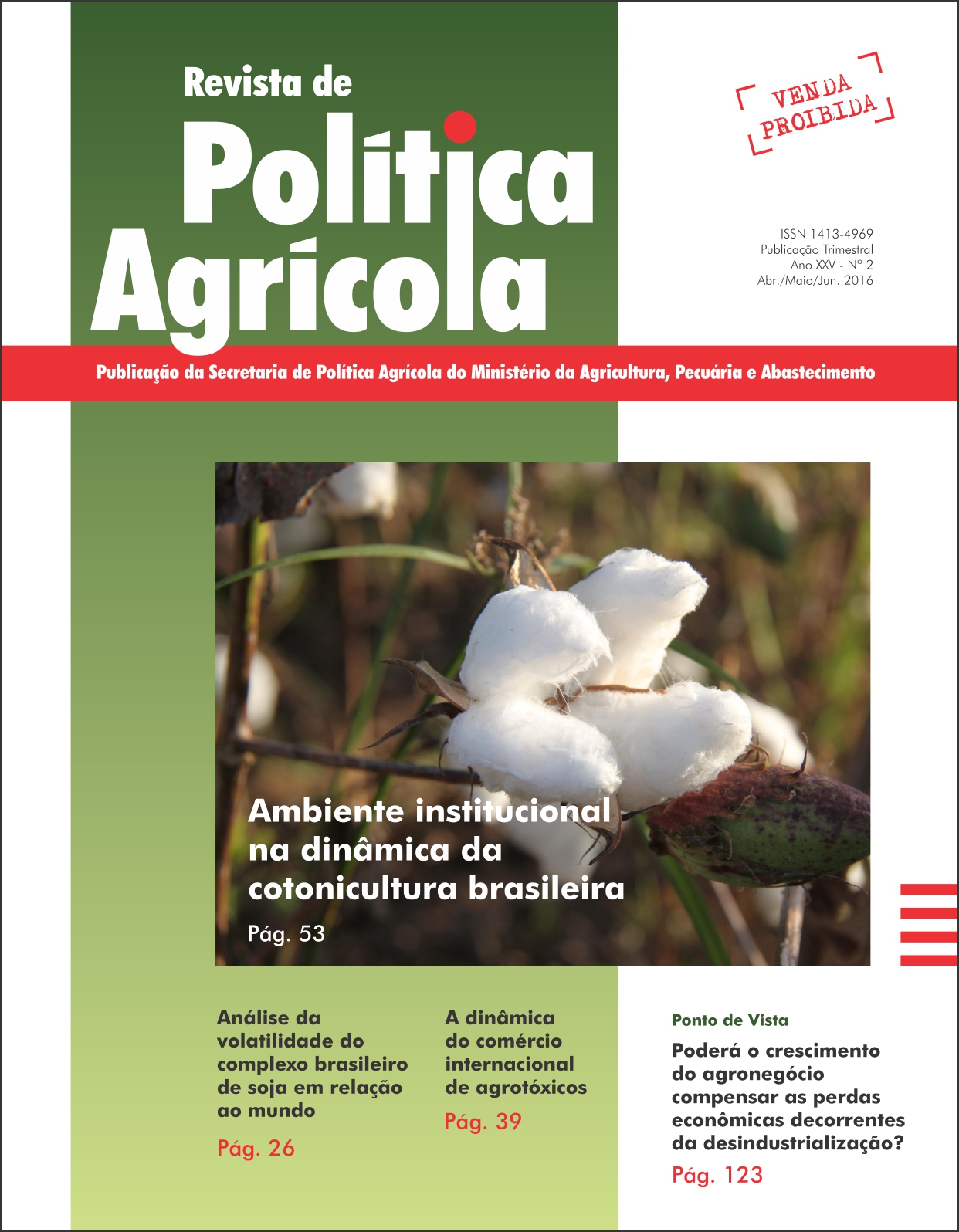
Downloads
How to Cite
Vieira, A. C. P., Lunas, D. A. L., & Garcia, J. R. (2016). The role of private institution environment in the dynamic of Brazilian cotton. Revista De Política Agrícola, 25(2), 53–66. Retrieved from https://rpa.sede.embrapa.br/RPA/article/view/1124
Issue
Section
Artigo Científico